Boost Brainpower with Mental Maths Magic!
Fun, Age-Specific Courses That Sharpen Focus, Speed & Accuracy
Trusted by 100+ families | Certified Instructors | Interactive Brain Training
At Innovative Generations in Sharjah, we offer powerful and engaging Mental Math and Rubik’s Cube Brain Development Programs for kids aged 4 to 15 years. Designed to boost brainpower while making learning fun, our programs help children enhance memory, improve focus, and sharpen problem-solving skills. Through our Abacus Mental Math training, kids learn to calculate quickly and accurately—without a calculator—by visualizing numbers and using hand movements that stimulate both sides of the brain.
At the same time, our Rubik’s Cube Program transforms play into skill-building, teaching logical thinking, pattern recognition, and spatial awareness as students master cubes of all kinds—from 3×3 to mirror. Whether your child is a beginner or ready for advanced challenges, our hands-on, expert-led approach ensures they grow in confidence, ability, and brain development every step of the way.
EXPLORE OUR Brain COURSES:
Abacus Mental Math Program
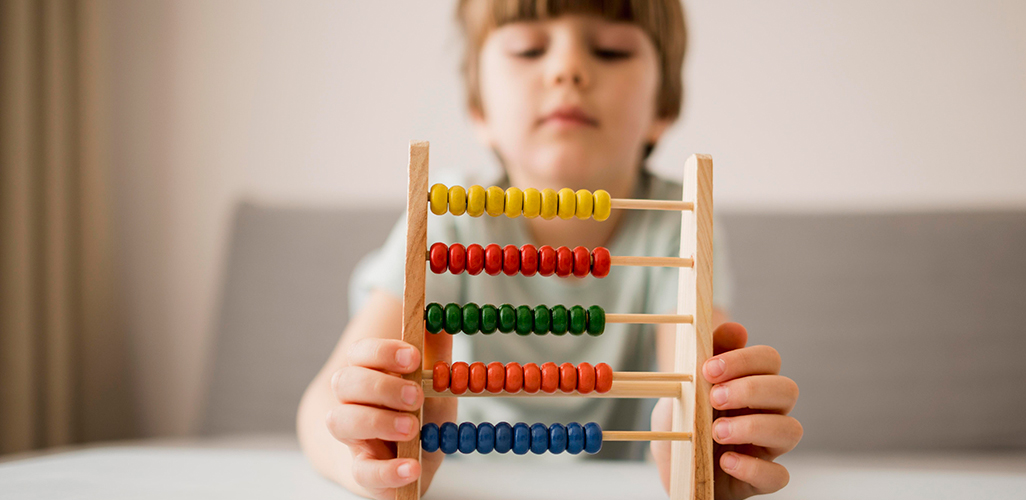
The Abacus Mental Math Program is a brain development initiative that uses mathematics as a tool to strengthen cognitive abilities through visualization and hand movement. Originating in Asia, the abacus has been widely recognized for stimulating whole-brain development.
By using their fngers to manipulate the beads, children establish a direct connection between motor activity and brain function. With consistent practice, students begin to visualize the abacus mentally—leading to fast, accurate calculations performed entirely within the mind, without any physical tool or calculator.
As students progress, they transition from using the physical abacus to mastering mental math through visualization alone. This process enhances not only mathematical skills but also promotes balanced development of both the left and right hemispheres of the brain.
Core Benefits of Abacus Training:
- Strengthens concentration and observation skills
- Enhances listening, processing, and comprehension of complex ideas
- Boosts focus, memory, and mental visualization
- Develops logical and analytical thinking
- Improves arithmetic understanding and mental calculation speed
- Encourages creativity and imagination
- Fosters discipline, confdence, and academic stamina
- Delivers fun and engaging learning that builds a strong foundation in math
Class Activities for Brain Development
Our program includes engaging activities designed to stimulate different areas of the brain and reinforce cognitive, motor, and creative skills. These tasks are integrated into lessons to support holistic development.
Brain Gym
A series of simple, intentional physical movements that activate both hemispheres of the brain. These psychomotor exercises improve:
- Hand-eye coordination
- Spatial and listening skills
- Focus and learning readiness
- Especially under stress, these movements help students avoid relying solely on their dominant hemisphere, promoting balanced brain usage.
Speed Writing:
This timed writing activity encourages students to focus on ideas without overthinking grammar or mistakes. It:
- Builds fluency and confidence in expression
- Encourages creative flow
- Helps track progress through word count goals
Memory Games:
Memory activities challenge students to retain and recall sequences, objects, or positions. They:
- Boost attention span and working memory
- Improve persistence and self-monitoring
- Offer instant feedback and encourage retrying
Riddles & Word Play:
Riddles are fun and mentally stimulating. They:
- Improve comprehension and vocabulary
- Encourage creative and lateral thinking
- Build collaboration and engagement through shared problem-solving
Both-Hand Writing & Spot the Difference:
These tasks activate multiple brain areas by:
- Strengthening visual processing and short-term memory
- Enhancing planning, focus, and spatial analysis
- Developing coordination by writing with the non-dominant hand These exercises train creativity and cognitive flexibility by challenging neural patterns.
Board Games & Strategy Activities:
Games like Connect Four teach:
- Strategic thinking and decision-making
- Fine motor control and visual coordination
- Social skills like turn-taking and following rules
LEVEL I
LEVEL I – Abacus Foundations
Course Content and Objectives:
- Introduction to the abacus tool and bead system
- Basic single-digit addition and subtraction
- Introduction to the Junior Formula (base number 5)
- Introduction to the Senior Formula (base number 10)
- Combination formulas using both base numbers (Senior Friend Combinations)
LEVEL II
LEVEL II – Double-Digit Development
Course Content and Objectives:
Focused practice on double-digit sums using the abacus
Single-digit addition/subtraction without abacus (mental visualization)
Double-digit addition/subtraction with abacus
Introduction to basic multiplication tables using abacus
Junior, Senior, and Combination formula applications on double digits
Triple-digit sums incorporating all formulas
Regular assessments (every 4–5 pages) to check understanding
- Oral drills from Junior Negative to Senior Positive formulas
LEVEL III
LEVEL III – Multiplication Mastery
Course Content and Objectives:
Extended multiplication tables using the abacus and mental visualization
Long single-digit addition/subtraction without abacus
Mixed single & double-digit addition/subtraction without abacus
Triple-digit problem-solving using advanced formulas
Multiplication: 2-digit × 1-digit (from tables 2–9)
Oral drills: Senior Positive to Combination Positive
LEVEL IV
LEVEL IV – Division Introduction
Course Content and Objectives:
Continued multiplication table reinforcement (with and without abacus)
Double-digit addition/subtraction without abacus
Introduction to negative number operations (with abacus)
Multiplication: 2-digit × 2-digit using abacus
Division using abacus (tables 2 to 9)
Oral practice up to Double-digit Junior Negative
LEVEL V
LEVEL V – Multiplication Without Abacus
Course Content and Objectives:
Visualization-based multiplication tables (mental level)
Triple-digit addition/subtraction without abacus
Multiplication: 2-digit × 1-digit without abacus
Division: 4-digit ÷ 1-digit and 3-digit ÷ 1-digit (with abacus)
Oral drills: Up to Double-digit Senior Negative
LEVEL VI
LEVEL VI – Long Calculations & Complex Division
Course Content and Objectives:
Advanced double-digit operations without abacus
Multiplication: 2-digit × 2-digit (without abacus)
Division: 5-digit ÷ 1-digit (with abacus)
Oral drills: Up to Combination Negative
LEVEL VII
LEVEL VII- Decimals & Advanced Multiplication
Course Content and Objectives:
Long addition/subtraction (up to 10-digit numbers) without abacus
Multiplication: 3-digit × 1-digit and 2-digit × 2-digit (without abacus)
Introduction to decimal calculations
Division: 4-digit ÷ 2-digit (with abacus)
Oral drills: Double-digit Senior Friend Combinations (Positive)
LEVEL VIII
LEVEL VIII – DMAS & Decimal Proficiency
Course Content and Objectives:
Long decimal addition and subtraction without abacus
Multiplication: 3-digit × 2-digit (without abacus)
Multiplication: 3-digit × 3-digit (with abacus)
Division: 4-digit ÷ 2-digit (without abacus), 5-digit ÷ 2-digit (with abacus)
Application of DMAS (Division, Multiplication, Addition, Subtraction) with and without abacus
Oral drills: Double-digit Senior Friend Combinations (Negative)
Class Division
Rubik’s Cube Brain Development Program
Rubik’s Cube solving is more than just a hobby; it’s a hands-on, brain-powered training system that fuses logical thinking with ne motor skills and memory enhancement. This curriculum is designed to stimulate both hemispheres of the brain by leveraging visual paerns, algorithms, and hand-eye coordination.
Like the abacus, solving a Rubik’s Cube requires a balance between visual memory, algorithmic processing, and spatial awareness. Students will begin with the classic 3×3 cube, then progress to the 2×2, 4×4, 5×5, and mirror
cube challenges.
Key Cognitive Benefits
- Enhances spatial awareness and 3D visualization
- Develops logical and algorithmic thinking
- Boosts memory retention and sequence recall
- Improves hand-eye coordination and ne motor skills
- Cultivates focus, patience, and problem-solving endurance
- Stimulates both the left and right hemispheres of the brain
- Increases self-condence through mastery-based learning
- Encourages creative and critical thinking
Class Activities for Brain Development
Our program includes engaging activities designed to stimulate different areas of the brain and reinforce cognitive, motor, and creative skills. These tasks are integrated into lessons to support holistic development.
Brain Gym
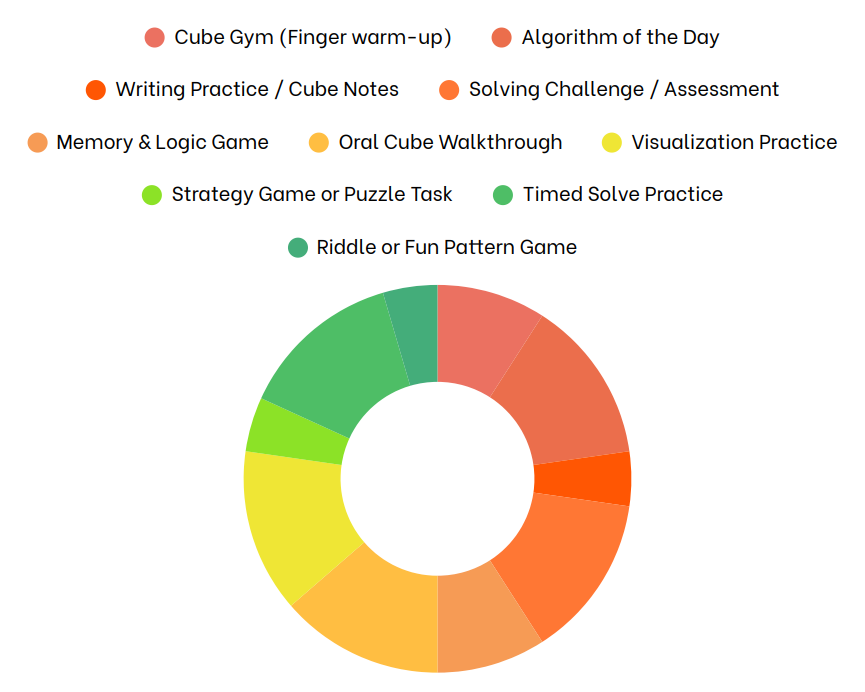
For Cubers A series of hand coordination and nger agility exercises done before every session to prep for rapid movements and quick mental processing.
Algorithm Relay:
Quick drills for memorizing and recalling step sequences.
Cube Memory Games:
Mini-games where students remember color sequences or part of an algorithm chain, reinforcing short-term and working memory.
Paern Recognition Challenges:
Students are given paerns to identify or recreate visually, enhancing their ability to visualize cube states and transitions.
Both-Hand Drills:
Students practice mirror algorithms and handle the cube with their non-dominant hand to encourage ambidexterity and brain flexibility.
Cube Art Challenges:
Create paerns like checkerboards, dots, and stripes.
Riddle Cubes:
Combine riddle solving with cube moves to boost creative thinking.
Strategy Games:
Game-based learning and pixel art paerns on solved cubes to encourage paern mastery and creativity. Activities like Connect Four to improve spatial logic and strategy.
Level I
Course Content and Objectives:
- Introduction to the cube, notation system (U, D, R, L, F, B), understanding cube structure, solving the White Cross, and placing white corners
- Completion of the rst layer, second layer edge insertion using beginner algorithms, intro to solving yellow cross.
- Yellow face orientation and corner placement, practicing full solves, building solving fluency and accuracy.
- Solving 2×2 cube using knowledge from 3×3, corner-only algorithms, and paern-solving drills.
- Introduction to 4×4 cube: identifying centers and edges, solving parity errors, and advanced visual tracking.
Level II
Course Content and Objectives:
Solving 5×5 cube: complex center pairing, edge formation, and multi-layer parity challenges.
Mirror Cube solving: learning shape-based recognition, adapting 3×3 solving logic, and handling abstraction.
Introduction to speedcubing, CFOP method basics (OLL/PLL), nger tricks, timing solves, and creative cube paern challenges.
Class Division
Abacus Mental Math Program
The Abacus Mental Math Program is a brain development initiative that uses mathematics as a tool to strengthen cognitive abilities through visualization and hand movement. Originating in Asia, the abacus has been widely recognized for stimulating whole-brain development.
By using their fngers to manipulate the beads, children establish a direct connection between motor activity and brain function. With consistent practice, students begin to visualize the abacus mentally—leading to fast, accurate calculations performed entirely within the mind, without any physical tool or calculator.
As students progress, they transition from using the physical abacus to mastering mental math through visualization alone. This process enhances not only mathematical skills but also promotes balanced development of both the left and right hemispheres of the brain.
Core Benefits of Abacus Training:
- Strengthens concentration and observation skills
- Enhances listening, processing, and comprehension of complex ideas
- Boosts focus, memory, and mental visualization
- Develops logical and analytical thinking
- Improves arithmetic understanding and mental calculation speed
- Encourages creativity and imagination
- Fosters discipline, confdence, and academic stamina
- Delivers fun and engaging learning that builds a strong foundation in math
Class Activities for Brain Development
Our program includes engaging activities designed to stimulate different areas of the brain and reinforce cognitive, motor, and creative skills. These tasks are integrated into lessons to support holistic development.
Brain Gym
A series of simple, intentional physical movements that activate both hemispheres of the brain. These psychomotor exercises improve:
- Hand-eye coordination
- Spatial and listening skills
- Focus and learning readiness
- Especially under stress, these movements help students avoid relying solely on their dominant hemisphere, promoting balanced brain usage.
Speed Writing
This timed writing activity encourages students to focus on ideas without overthinking grammar or mistakes. It:
- Builds fluency and confidence in expression
- Encourages creative flow
- Helps track progress through word count goals
Memory Games
Memory activities challenge students to retain and recall sequences, objects, or positions. They:
- Boost attention span and working memory
- Improve persistence and self-monitoring
- Offer instant feedback and encourage retrying
Riddles & Word Play
Riddles are fun and mentally stimulating. They:
- Improve comprehension and vocabulary
- Encourage creative and lateral thinking
- Build collaboration and engagement through shared problem-solving
Both-Hand Writing & Spot the Difference
These tasks activate multiple brain areas by:
- Strengthening visual processing and short-term memory
- Enhancing planning, focus, and spatial analysis
- Developing coordination by writing with the non-dominant hand These exercises train creativity and cognitive flexibility by challenging neural patterns.
Board Games & Strategy Activities
Games like Connect Four teach:
- Strategic thinking and decision-making
- Fine motor control and visual coordination
- Social skills like turn-taking and following rules
| LEVELS | Course Content and Objectives |
|---|---|
| LEVEL I Abacus Foundations |
|
| LEVEL II Double-Digit Development |
|
| LEVEL III Multiplication Mastery |
|
| LEVEL IV Division Introduction |
|
| LEVEL V Multiplication Without Abacus |
|
| LEVEL VI Long Calculations & Complex Division |
|
| LEVEL VII Decimals & Advanced Multiplication |
|
| LEVEL VIII DMAS & Decimal Profciency |
|
Class Division
Rubik’s Cube Brain Development Program
Rubik’s Cube solving is more than just a hobby; it’s a hands-on, brain-powered training system that fuses logical thinking with ne motor skills and memory enhancement. This curriculum is designed to stimulate both hemispheres of the brain by leveraging visual paerns, algorithms, and hand-eye coordination.
Like the abacus, solving a Rubik’s Cube requires a balance between visual memory, algorithmic processing, and spatial awareness. Students will begin with the classic 3×3 cube, then progress to the 2×2, 4×4, 5×5, and mirror
cube challenges.
Key Cognitive Benefits
- Enhances spatial awareness and 3D visualization
- Develops logical and algorithmic thinking
- Boosts memory retention and sequence recall
- Improves hand-eye coordination and ne motor skills
- Cultivates focus, patience, and problem-solving endurance
- Stimulates both the left and right hemispheres of the brain
- Increases self-condence through mastery-based learning
- Encourages creative and critical thinking
Class Activities for Brain Development
Our program includes engaging activities designed to stimulate different areas of the brain and reinforce cognitive, motor, and creative skills. These tasks are integrated into lessons to support holistic development.
Brain Gym: for Cubers A series of hand coordination and nger agility exercises done before every session to prep for rapid movements and quick mental processing.
Algorithm Relay: Quick drills for memorizing and recalling step sequences.
Cube Memory Games: Mini-games where students remember color sequences or part of an algorithm chain, reinforcing short-term and working memory.
Paern Recognition Challenges: Students are given paerns to identify or recreate visually, enhancing their ability to visualize cube states and transitions.
Both-Hand Drills: Students practice mirror algorithms and handle the cube with their non-dominant hand to encourage ambidexterity and brain flexibility.
Cube Art Challenges: Create paerns like checkerboards, dots, and stripes.
Riddle Cubes: Combine riddle solving with cube moves to boost creative thinking.
Strategy Games: Game-based learning and pixel art paerns on solved cubes to encourage paern mastery and creativity. Activities like Connect Four to improve spatial logic and strategy.
LEVELS Course Content and Objectives
LEVEL I
LEVEL II
Class Division
WHY CHOOSE INNOVATIVE GENERATIONS FOR MENTAL MATHS?
Structured, Age-Appropriate Curriculum
Every course is designed to match your child's developmental stage, ensuring learning is engaging and effective.
Certified Mental Math Instructors
Our educators are trained in mental math strategies, with a deep understanding of how children learn best.
Interactive & Play-Based Learning
We integrate games, activities, and group tasks to make math fun, not stressful.
Builds Core Brain Skills
Children improve their focus, memory, logic, and confidence, benefiting all areas of learning.
Supports Academic Excellence
Mental math helps kids perform better in school, handle tests with ease, and reduce math anxiety.
Safe, Supportive Environment
Small class sizes ensure individual attention in a space that encourages creativity and growth.
Hear from our
WHAT PARENTS ARE SAYING
Is prior math knowledge needed?
No. The courses are designed for all levels and focus on mental strategies, not prior textbook knowledge.
Are these courses suitable for children struggling with math?
Yes. Our courses are great for both beginners and those who want to boost their math confidence.
How are classes conducted?
Through fun, interactive activities—no boring lectures! Kids actively participate in every session.
Do you offer online options?
Yes, the advanced level is also available online.
Is there a certificate?
Yes, all students receive a certificate of completion.
Can we try a class first?
Absolutely! Book a free trial session to experience the magic of Mental Maths.