
RPA vs AI: What's the Difference and How Do They Work Together?
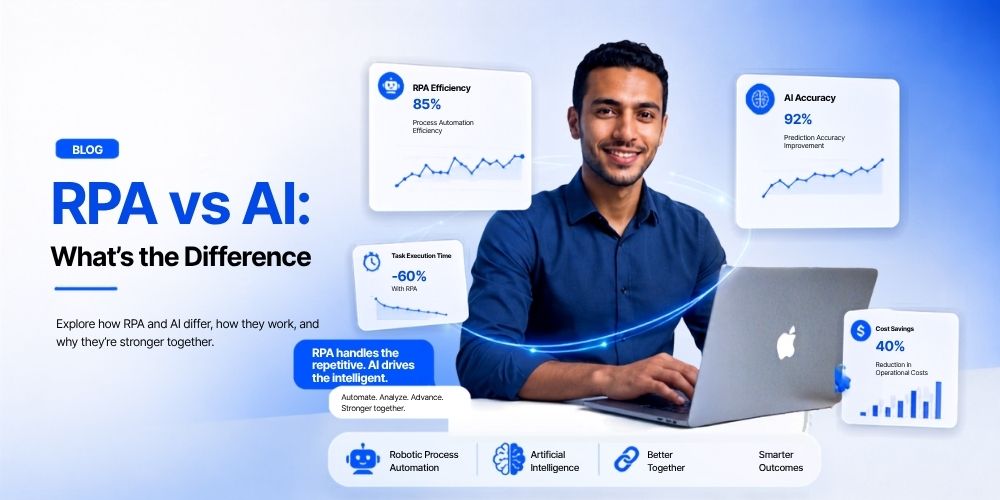
Businesses are increasingly using automation and artificial intelligence to reduce repetitive work, improve productivity and make better use of data. Two technologies frequently discussed in modern business automation are Robotic Process Automation (RPA) and Artificial Intelligence (AI). Although they are closely related, RPA and AI serve different purposes. RPA is primarily designed to automate structured, repetitive tasks by following predefined rules, while AI can analyze information, recognize patterns, understand language and support more adaptive decision-making.
At IG Institute, we help learners develop practical, career-focused skills through programs such as our RPA Course in Dubai, designed to introduce learners to robotic process automation and its applications in modern business environments.
When combined, RPA and AI can create intelligent automation, allowing organizations to automate not only routine actions but also parts of processes that require data analysis and interpretation. Understanding how these technologies differ—and how they can work together—is increasingly valuable for professionals looking to build future-ready IT and automation skills.
What Is RPA?

Robotic Process Automation (RPA) uses software bots to perform repetitive digital tasks that would otherwise be completed manually. An RPA bot can interact with applications, websites, spreadsheets and business systems in a way that mimics predefined human actions. For example, an RPA bot could collect information from an Excel spreadsheet, enter it into a business application and generate a report.
RPA works particularly well when a process is:
- Repetitive
- Rule-based
- Structured
- High-volume
- Predictable
- Based on clearly defined steps
Common RPA applications include data entry, invoice processing, report generation, data migration and transferring information between systems.
What Is Artificial Intelligence?
Artificial Intelligence (AI) refers to technologies that enable computer systems to perform tasks that normally require aspects of human intelligence. Depending on the application, AI can involve machine learning, natural language processing, computer vision, reasoning and pattern recognition. Unlike traditional rule-based automation, AI can work with large amounts of data and, in many applications, identify patterns or provide predictions and recommendations. For example, an AI system can analyze customer messages, identify their intent and classify them before the next step of a business process is triggered.
AI is particularly useful when a process involves:
- Unstructured data
- Text or natural language
- Images or documents
- Pattern recognition
- Predictions
- Classification
- Complex or changing inputs
At IG Institute, we empower learners with practical, industry-relevant skills through our AI Course in Dubai, covering essential concepts in artificial intelligence, machine learning, automation, and real-world applications across today’s business and technology landscape.
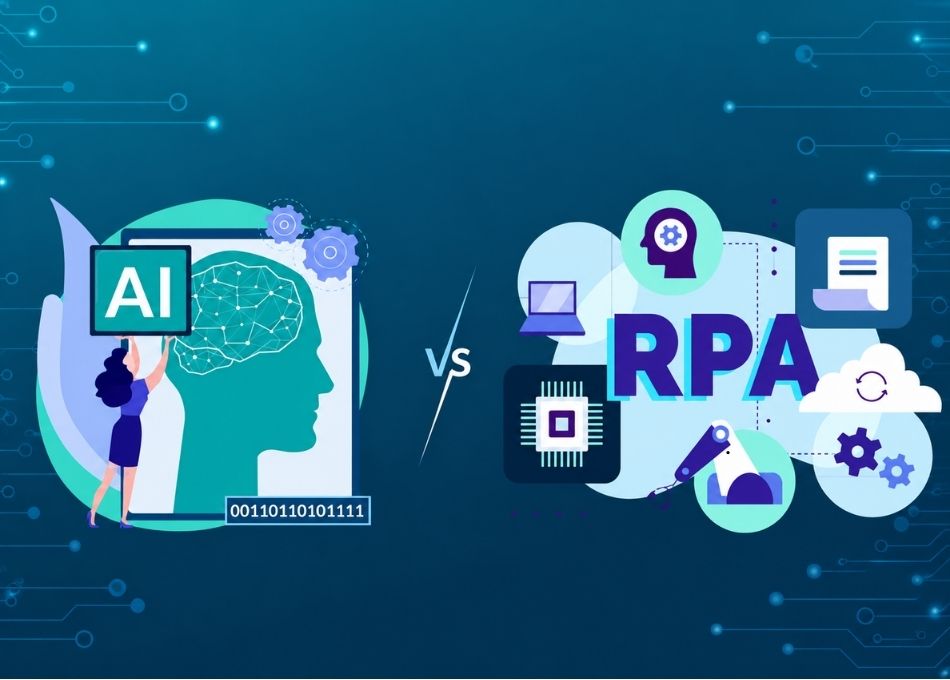
RPA vs AI: What's the Difference?
The easiest way to understand the difference is to think of RPA as the technology that executes predefined tasks, while AI adds intelligence to processes that require interpretation or decision-making.
| RPA | AI |
|---|---|
| Follows predefined rules | Can analyze data and recognize patterns |
| Process-driven | Data-driven |
| Best for repetitive tasks | Best for complex or variable information |
| Works well with structured data | Can work with structured and unstructured data |
| Executes defined instructions | Can generate predictions, classifications or recommendations |
| Generally predictable | Can adapt depending on the AI model and data |
| Automates the "how" | Can help determine the "what" or "next step" |
IBM describes the distinction by noting that RPA is process-driven, whereas AI is data-driven. RPA bots follow processes defined by users, while AI systems can use techniques such as machine learning to recognize patterns in data.
RPA and AI Are Not Competitors
One common misconception is that businesses need to choose between RPA and AI. In reality, RPA and AI can complement each other. Consider an invoice processing example.
An RPA bot can collect invoices from an email inbox and move the information into a business system. However, invoices may contain different layouts, formats or unstructured information. AI can help interpret the document, extract relevant information and classify it. RPA can then take the extracted information and perform the required actions in the company’s systems.
This creates a workflow where:
AI understands → RPA executes
This combination is often referred to as intelligent automation.
How Do RPA and AI Work Together?
A typical intelligent automation workflow can involve several stages.
1. AI Understands the Information
AI can analyze information from documents, emails, customer messages or other sources.
For example, an AI system could identify whether an incoming email is a sales enquiry, support request or invoice.
2. AI Makes a Classification or Recommendation
The AI system can analyze the information and determine what category or action may be appropriate.
For example:
Invoice → Finance Department
Customer Complaint → Customer Service
Job Application → HR
3. RPA Performs the Repetitive Actions
Once the information has been classified, an RPA bot can execute the predefined workflow.
It could update a database, enter information into an ERP system, send a notification or generate a report.
4. Human Employees Handle Exceptions
Processes that require human judgment can still be routed to employees.
This allows automation to handle predictable work while people focus on exceptions, strategic decisions and tasks requiring deeper judgment.
Real-World Examples of RPA + AI
Intelligent Invoice Processing
AI can extract information from invoices and identify relevant fields such as supplier name, invoice number and amount.
RPA can then enter the extracted information into accounting or ERP systems.
Customer Service Automation
AI can analyze customer messages and determine their intent or sentiment.
RPA can then perform predefined actions, such as updating customer records, creating tickets or retrieving information from business systems.
HR Automation
AI can help analyze CVs and classify candidates based on predefined recruitment criteria.
RPA can then transfer candidate information into an HR system, send notifications or schedule predefined workflow actions.
Financial Services
AI can help identify unusual patterns or classify financial information, while RPA can perform repetitive data processing and system updates.
Data Management
AI can help identify, classify or interpret information, while RPA can transfer and update that information across multiple applications.
The combination can reduce manual intervention and help organizations process information more efficiently.
What Is Intelligent Automation?
Intelligent automation combines technologies such as RPA and AI to automate broader business processes. Instead of simply telling a bot to follow a fixed sequence of actions, intelligent automation can introduce capabilities such as data interpretation, pattern recognition, natural language processing and decision support.
For example:
Traditional RPA:
Receive file → Read defined fields → Enter data → Generate report
AI + RPA:
Receive document → AI interprets information → AI classifies data → RPA updates systems → Workflow continues → Exception is sent to employee
This combination allows businesses to move beyond simple task automation toward more connected and intelligent workflows.
RPA vs AI: Which One Should You Learn?
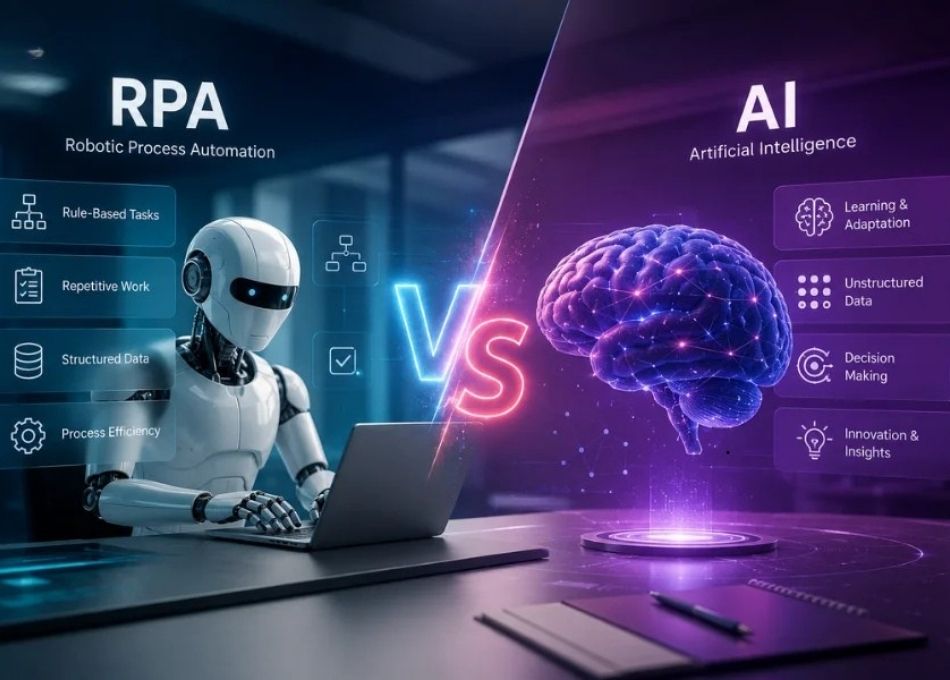
The answer depends on your career goals. If you are interested in business process automation, workflow automation and repetitive task automation, learning RPA can be a strong starting point. If you are interested in machine learning, data analysis, natural language processing and intelligent systems, AI may be the better direction. For professionals who want to work with modern automation technologies, learning both can provide a broader understanding of how businesses are building intelligent workflows.
Why Learn RPA?
RPA can be useful for professionals interested in:
- Business process automation
- Workflow management
- Digital transformation
- Process optimization
- Automation testing
- RPA development
- Business operations
Why Learn AI?
AI can be useful for professionals interested in:
- Machine learning
- Data analytics
- Generative AI
- Natural language processing
- Computer vision
- Predictive analytics
- AI-powered business solutions
Why Learn Both?
The combination can help professionals understand both sides of intelligent automation:
AI provides intelligence, while RPA can provide execution.
This makes knowledge of both technologies particularly valuable for professionals working toward automation-focused roles.
RPA and AI Career Opportunities
As organizations automate more business processes, professionals with automation and AI skills can work across several industries.
Potential career paths include:
- RPA Developer
- RPA Business Analyst
- Automation Specialist
- Intelligent Automation Consultant
- AI Specialist
- Machine Learning Professional
- Data Analyst
- Business Process Analyst
- Automation Engineer
The exact responsibilities and technical requirements vary by organization, but a combination of automation, analytical and problem-solving skills can help professionals prepare for technology-focused careers.
What Is the Future of RPA and AI?
The future of automation is increasingly moving toward systems that combine automation, AI, data and intelligent decision-making. Traditional RPA remains useful for stable and predictable processes, while AI-based systems can help address changing environments and unstructured information. Modern AI agents can also reason about goals and determine actions dynamically, creating new possibilities for enterprise automation.
Rather than completely replacing RPA, AI can extend what automation systems are capable of doing. This means the future may not be RPA vs AI, but rather:
RPA + AI = Intelligent Automation
Learn RPA and Build Future-Ready Skills with IG Institute
Understanding the difference between RPA and AI is becoming increasingly important for professionals who want to build careers in automation and emerging technologies. At IG Institute, learners can explore technology-focused training designed to develop practical and career-oriented skills. An RPA course can help learners understand automation concepts, workflows and the technologies used to automate repetitive business processes. Whether you are a beginner exploring automation or a professional looking to expand your IT skill set, developing knowledge of RPA alongside AI can help you better understand the future of intelligent business automation.
Ready to build your automation skills? Explore the RPA training options at IG Institute and take the next step toward a future-ready technology career.


